
Interview Coming Up? Two Crystals and a Week to Get Ready
By Hank Mason, G.I.A. Graduate Gemologist
It is two in the morning and you are still awake. The interview is at ten. You have read the job posting so many times you could recite it, you have picked out what you are wearing, and none of it has helped, because the thing you are actually worried about is not the questions. It is you. Whether your voice will hold. Whether your hands will give you away. Whether you will sit down in that chair and become a smaller, quieter version of the person who deserves this job.
If that is where you are tonight, you are in extremely good company. It happens to nearly everyone, including people who are very good at what they do.

Almost nobody sleeps well the night before. That part is normal.
Here is what might surprise you, though. The part of an interview that goes wrong for most people is not the part they spend the week preparing. And it happens to be the part a crystal can genuinely help with — not as a charm you carry and hope about, but as something you practise with beforehand, the way an athlete practises with a routine until it becomes automatic.
Let me walk you through what really decides an interview, which two stones help with what, and exactly how to work with them in whatever time you have left.
What Really Decides an Interview
Plenty of things matter, and I am not going to pretend otherwise. Your experience matters. Knowing the work matters. How you dress, how you speak, whether you have looked into the company — all of it counts, and most of it is already settled by the time you are lying awake at two in the morning. You cannot get five more years of experience by Thursday.
But researchers who study hiring have found two things that make an enormous difference, and both of them are still open to you in the week you have left.
The first is how nervous you look, which turns out to be a very different thing from how nervous you feel. This is the one that catches good people out. When an interviewer notices a hand that will not stay still, or a voice that keeps climbing, something quietly shifts in how they see you. They do not think "poor thing, she is nervous." They think you seem less capable. It happens below the level of a conscious decision, and it happens even when your answers are perfectly good. You can be the strongest candidate in the building and lose the job to somebody who simply looked calmer than you did.

Interviewers do not think "she is nervous." They think "she seems less capable." It happens without them deciding to.
Nobody is asking you to stop being nervous. Everyone is nervous. You only need to keep it out of your hands for forty minutes.
The second thing is whether you actually say good things about yourself, and this is the larger of the two. Candidates who make their own case — who state plainly what they are good at and give an example — are rated far more highly than candidates who wait politely to be asked. It is the biggest single advantage available to anyone sitting in that chair, and hardly anyone uses it, because saying you are good at something feels uncomfortably close to boasting.
It only becomes boasting when it is a string of adjectives. I am hard-working. I am a real people person. I am very organised. Anybody can say that, and it proves nothing. What works is one specific claim with one piece of evidence attached to it. I took over a route that had lost four customers the year before, and we finished that year up two. That is not bragging. That is a fact, and facts are difficult to argue with.
So: steady hands, and the willingness to speak plainly about what you are worth. There is a stone for each, and there is a way to work with each one that makes the difference.
Tiger's Eye, for the Nerves That Show
Tiger's eye is the old courage stone. People have carried it for a very long time for the strength to be brave — which, and this matters, is not the same as not being afraid. You are going to be afraid. Tiger's eye is for the part where your hands stay still anyway.
It is also a genuinely lovely thing to hold, and I say that as someone who has spent a career looking at stones. That band of golden light that slides across the surface as you turn it is called chatoyancy. It comes from fine parallel fibres running all the way through the stone, every one of them catching the light at the same angle at the same moment. Turn it a little and the whole band moves with you, like something alive is looking back. The old name for it was the eye of the tiger for exactly that reason.

That moving band is chatoyancy — thousands of parallel fibres, all catching the light at once.
The energy of tiger's eye is steadying rather than exciting. It settles. It brings you back down into your body when your thoughts have run off somewhere ahead of you, which is precisely what happens in a waiting room.
How to work with it
This takes about five minutes a day, and you want four or five days if you can get them.
Sit down somewhere quiet at a time when nothing is happening and nothing is at stake. Not the night before. Not in the car. Somewhere ordinary and safe, on your own sofa, with the phone face down.
Breathe out for longer than you breathe in — four counts in, six counts out — and keep going until you feel your shoulders come down. You will know when it happens. There is a particular moment where your jaw lets go and your breathing stops being something you are managing.
Once you are genuinely settled, and not a second before, close your hand around the tiger's eye and squeeze it firmly for about three seconds, then let go. Do that twenty times in the sitting, always at the same point, always the same grip.
What you are doing is teaching your body that this particular squeeze belongs to this particular calm. After a few days of it, the squeeze starts bringing the calm back with it. This is a well-established technique in its own right, and the stone gives it something to live in — something with weight and warmth that you can hold in a corridor without anyone knowing what you are doing.
One warning, and it is important. Do not practise this while you are already worked up. If you squeeze the stone in the middle of a panic, you teach yourself that the stone means panic, and you will have built the exact opposite of what you wanted. Calm first. Always calm first, then the squeeze.

Calm first, then the squeeze. Do it in the wrong order and you teach the stone to mean panic.
Because you use this one on your own, before anybody is watching, it can be a decent-sized piece. Something with heft to it. It can live in your coat pocket and never come out in front of another person.
Here is the kind of thing I mean. Picture someone — call her Maria — who has been out of work for five months and has an interview on Thursday for a job she can absolutely do. She knows the work cold. But the last time she sat in one of those rooms, the interviewer asked her to talk a little about herself, and she heard her own voice go thin and quick, and she watched something quietly close behind his eyes. The polite email came four days later. This time she starts on the Sunday. Five minutes a night on the sofa with a tiger's eye in her hand, and by Thursday morning, sitting in the car park with the engine off, her hands know what to do without her having to ask them.
Carnelian, for Saying What You Are Worth
Carnelian does the opposite job, and it is not a calming stone. You would not want it to be. Calm is not what fails you halfway through an interview. Silence is.
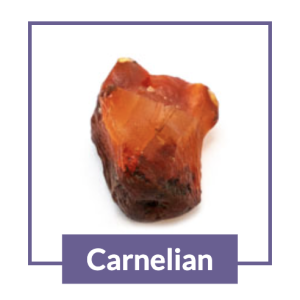
Carnelian is a warm, driving, orange-red stone that has been associated with courage and motivation for thousands of years. Roman soldiers carried it. Roman signet rings were very often cut from carnelian too, for a purely practical reason — hot sealing wax will not stick to it — and so it became, quite literally, the stone people used to press their own name into things.

Hot sealing wax will not stick to carnelian. That is how it became the stone people pressed their names with
Which is more or less what we are asking of it here. Putting your name on your own work, out loud, in front of a stranger who has the power to say no.
How to work with it
This one is practised in the opposite direction from the tiger's eye. Not away from pressure, but into it.
Start by writing down three things you are genuinely good at, each with one real example attached. Not adjectives. Actual things that happened. Those three are what you are training yourself to be able to say.
Then hold the carnelian, squeeze it once, and say one of them out loud. Always in that order — squeeze, then speak. Do that twenty or thirty times over a couple of sittings. It will feel ridiculous the first few times. Everybody finds it excruciating to hear themselves say something good about themselves in an empty room. That discomfort is the whole point, and it wears off, which is exactly why you are doing it here rather than in the interview.
Then make it harder. Say them to a camera and watch it back. Say them to a friend who will interrupt you and ask awkward follow-up questions. Say them inside a full mock interview where you do not know which question is coming next.
This is close to how paratroopers are taught. They rehearse the exit from the aircraft on the ground, twenty or thirty times, long before they go anywhere near a plane. Then from a thirty-four-foot tower. Then at twelve hundred feet with the wind roaring past the open door and every instinct in the body saying absolutely not. The movement never changes. Only the pressure does. And by the time it is real, nobody is deciding anything — the tap comes on the shoulder and the body simply goes.
That is what you are building here. Not confidence exactly, because confidence comes and goes and cannot be relied upon at ten in the morning. Something more like a groove worn deep enough that you will follow it even when you are frightened.
Practise out loud, every time. The thing that deserts you in that room is not your memory. You will remember your three claims perfectly well. What deserts you is the willingness to say them.

It feels ridiculous the first few times. That is exactly why you do it here and not in the interview.
Because you will be using this one while somebody is looking directly at you, keep it small. A tumbled piece that sits in a pocket you can reach while seated. The squeeze needs to be invisible — one press against your leg, nothing anybody could see. A hand visibly working away at something in a pocket is the very tell you have spent all week getting rid of.
Here is where it usually goes wrong. Somebody gets asked why they should get the job. What they actually did was take over a route that had been losing customers for two years and turn it around inside twelve months. What comes out of their mouth is that they are hard-working and good with people, because the true version feels like showing off and there is a stranger looking at them. They walk out to the car knowing they never said the one thing that would have won it, and there is no way to go back in and add it.
That moment is what the week of carnelian practice is for. Not the nerves. That moment.
The Day Itself
In the car, or on the train, take out the tiger's eye. Four counts in, six counts out, and squeeze. Two or three rounds of that. Do not rush it and do not do it while you are still driving.

Four counts in, six counts out, one squeeze. Two or three rounds, and do not rush it.
[IMAGE 7 — THE MOMENT: hands in the lap in a parked car, office building beyond] Caption: Four counts in, six counts out, one squeeze. Two or three rounds, and do not rush it.
Outside the door, once more. One breath out, one squeeze, shoulders down. Then put it away in your coat and leave it there.
In the chair, you are working with the carnelian. When a question opens the door to one of your three claims — tell me about yourself, why should we choose you, what would you bring to this — press once, and say it. In a good interview that will happen three or four times, and you will feel it coming each time.
Afterwards, whatever happened, thank them both. That sounds sentimental and I mean it practically. You are closing the loop on a week of work, and you will want these two stones again.
If You Can Only Get One
Get the carnelian.
The nerves are real and they cost you, but they are survivable, and interviewers do make some allowance for them. Never making your case at all is the one that quietly loses you the job to someone less qualified who was simply willing to say what they were good at. If you have to choose, choose the one that gets your voice working.
A Final Word
No stone is going to get you hired. I would not want you walking in there believing otherwise, and I would rather say so plainly than sell you something dressed up as a guarantee.
What these two stones do is give you a physical, practised way back to yourself at the two moments it is easiest to lose the thread — the corridor, and the chair. They give your hands somewhere to go. And because you spent a week working with them, they arrive in that room carrying every hour of that preparation with them, which is not a small thing to have in your pocket when you are frightened.
The rest is you, and it always was. You were good enough to get the interview. The whole point of the week is making sure the person in that room gets to see it.

Whatever happened in there, thank them both. You are closing a week of work, and you will want these two again.
Learn more about these stones: Tiger's Eye · Carnelian
Shop Now